Key Takeaways
- Vodka can be made from any fermentable ingredient containing starch or sugar, including grains, potatoes, grapes, and even milk whey
- Multiple distillation passes increase alcohol purity—most premium vodkas undergo at least three distillations to reach 95-96% ABV before dilution
- Filtration through activated charcoal removes remaining impurities and congeners that create flavor, producing vodka's neutral character
- Water quality significantly impacts final taste—many distilleries use glacial, limestone-filtered, or specially treated water sources
- The column still revolutionized vodka production by enabling continuous distillation with higher purity than traditional pot stills
What Raw Materials Are Used to Make Vodka?
Vodka production begins with selecting a fermentable base ingredient containing either starch or sugar. According to the Distilled Spirits Council, the choice of base material influences production costs, regional traditions, and subtle characteristics in the final spirit, though the goal remains creating a neutral profile.
The most common base materials include:
- Grains: Wheat, rye, corn, and barley are traditional choices, particularly in Russia, Poland, and Ukraine. Wheat produces a slightly sweet, creamy vodka, while rye creates a spicier, more robust character. Grain-based vodkas dominate the premium market.
- Potatoes: Popular in Poland and Scandinavia, potatoes yield a heavier, earthier vodka with a distinctive creamy mouthfeel. Potato vodka requires more extensive processing because potatoes contain less fermentable sugar per pound than grains.
- Grapes and Fruit: French vodkas often use grapes, creating a slightly fruity undertone. These base materials ferment quickly due to high natural sugar content.
- Sugar Beets and Molasses: These high-sugar crops produce neutral, cost-effective vodka and are common in industrial production.
- Alternative Sources: Modern distillers experiment with quinoa, corn, soy, and even milk whey, each contributing unique production characteristics.
The selected base material must undergo milling or preparation before fermentation. Grains are ground into meal to expose starches, while potatoes are steamed and mashed. This preparation step maximizes the surface area for enzymatic conversion during the next phase.
How Does Fermentation Convert Ingredients Into Alcohol?
Fermentation is the biochemical process where yeast converts sugars into ethanol and carbon dioxide. For starchy base materials like grains and potatoes, an additional step called saccharification must occur first. According to research published in the Journal of Fermentation Technology, this two-stage conversion is essential for maximizing alcohol yield from complex carbohydrates.
What Happens During Saccharification?
Saccharification converts starches into fermentable sugars using enzymes. Distillers add malted grains containing natural enzymes (amylase) or introduce commercial enzyme preparations to the mash. The mixture is heated to specific temperatures—typically between 60-70°C (140-158°F)—where enzymes break down long-chain starches into simple sugars like glucose and maltose. This process takes 1-2 hours and creates a sweet liquid called wort.
What Role Does Yeast Play in Vodka Production?
Once sugars are available, distillers introduce yeast strains—most commonly Saccharomyces cerevisiae—into the cooled wort. Yeast cells metabolize sugars through anaerobic respiration, producing ethanol, carbon dioxide, heat, and small amounts of congeners (flavor compounds). The American Homebrewers Association notes that fermentation temperature control is critical: vodka fermentation typically occurs between 20-30°C (68-86°F) over 2-5 days.
During fermentation, the alcohol content reaches approximately 8-15% ABV depending on sugar concentration and yeast strain efficiency. The resulting liquid, called wash or beer, contains ethanol, water, residual sugars, yeast cells, and hundreds of congener compounds that must be removed through distillation.
Related: Best Gins for Beginners — Easy-Drinking Choices | WhichBrewForYou
What Is the Distillation Process for Vodka?
Distillation separates alcohol from the fermented wash by exploiting the different boiling points of compounds in the mixture. Ethanol boils at 78.4°C (173°F), significantly lower than water's 100°C (212°F) boiling point. This differential allows distillers to selectively vaporize alcohol, leaving behind water, solids, and many impurities.
How Does Column Still Distillation Work?
Modern vodka production predominantly uses continuous column stills (also called Coffey stills), which revolutionized spirit production in the 1830s. According to Distiller, column stills enable continuous operation with higher efficiency and purity than batch pot stills.
In a column still system:
- Fermented wash enters near the top of a tall vertical column containing multiple perforated plates
- Steam rises from the bottom, heating the descending wash
- As wash cascades down through the plates, volatile compounds (including ethanol) vaporize and rise
- Each plate acts as a mini-distillation stage, progressively concentrating alcohol vapor
- The vapor exits at the top with alcohol content reaching 95-96% ABV
- Heavier compounds (water, solids, high-boiling congeners) drain from the bottom as stillage
Column stills produce exceptionally pure alcohol because the vapor passes through dozens of theoretical plates—each plate representing one distillation pass. A typical vodka column still contains 40-70 plates, effectively performing 40-70 distillations in a single continuous operation.
How Many Times Is Vodka Distilled?
Marketing claims frequently tout "triple-distilled" or "five-times distilled" vodka, but these numbers can be misleading. When using column stills, a single pass achieves the equivalent of multiple distillations. The practical significance lies in total theoretical plates, not the number of times spirit passes through stills.
However, some premium distilleries do use multiple distillation passes for additional refinement:
| Distillation Passes | Typical Purity | Purpose |
|---|---|---|
| 1 pass (column) | 95-96% ABV | Standard for most vodkas; legally sufficient |
| 2-3 passes | 96-96.5% ABV | Removes additional congeners; marketing differentiation |
| 4-5 passes | 96.5-97% ABV | Ultra-premium positioning; diminishing returns on purity |
Research from the National Center for Biotechnology Information demonstrates that alcohol purity plateaus around 96% ABV in typical distillation systems due to azeotrope formation—a point where the vapor composition equals the liquid composition, preventing further separation through conventional distillation.
What Are Heads, Hearts, and Tails in Distillation?
During distillation, different compounds vaporize at different temperatures, creating three fractions that distillers must separate:
Heads (foreshots): The first vapors contain volatile compounds like methanol, acetone, and aldehydes that boil below ethanol's boiling point. These compounds smell harsh, taste terrible, and in the case of methanol, are toxic. Distillers discard or redistill heads, which comprise roughly 5% of the run.
Hearts: The middle fraction contains primarily ethanol with minimal congeners. This is the keeper portion that becomes vodka. Hearts represent approximately 80-85% of the distillation run and emerge when vapor temperature stabilizes around 78-82°C.
Tails (feints): The final fraction contains heavier alcohols (fusel oils), proteins, and other high-boiling compounds that create oily texture and off-flavors. Tails comprise the remaining 10-15% and are typically redistilled or discarded.
Experienced distillers make cuts between these fractions based on temperature, taste, smell, and sometimes laboratory analysis. For vodka, cuts are made narrowly to capture only the cleanest heart fraction, maximizing neutrality.
Why Is Filtration Essential in Vodka Production?
Even after multiple distillations reaching 95-96% ABV, vodka still contains trace congeners, oils, and impurities that affect taste, aroma, and mouthfeel. Filtration is the final purification step that creates vodka's signature clean, neutral character.
How Does Activated Charcoal Filtration Work?
Activated charcoal (also called activated carbon) is the most common filtration medium in vodka production. According to a study in Chemical Engineering Journal, activated charcoal's porous structure provides enormous surface area—up to 3,000 square meters per gram—allowing it to adsorb organic compounds, oils, and other impurities through physical and chemical attraction.
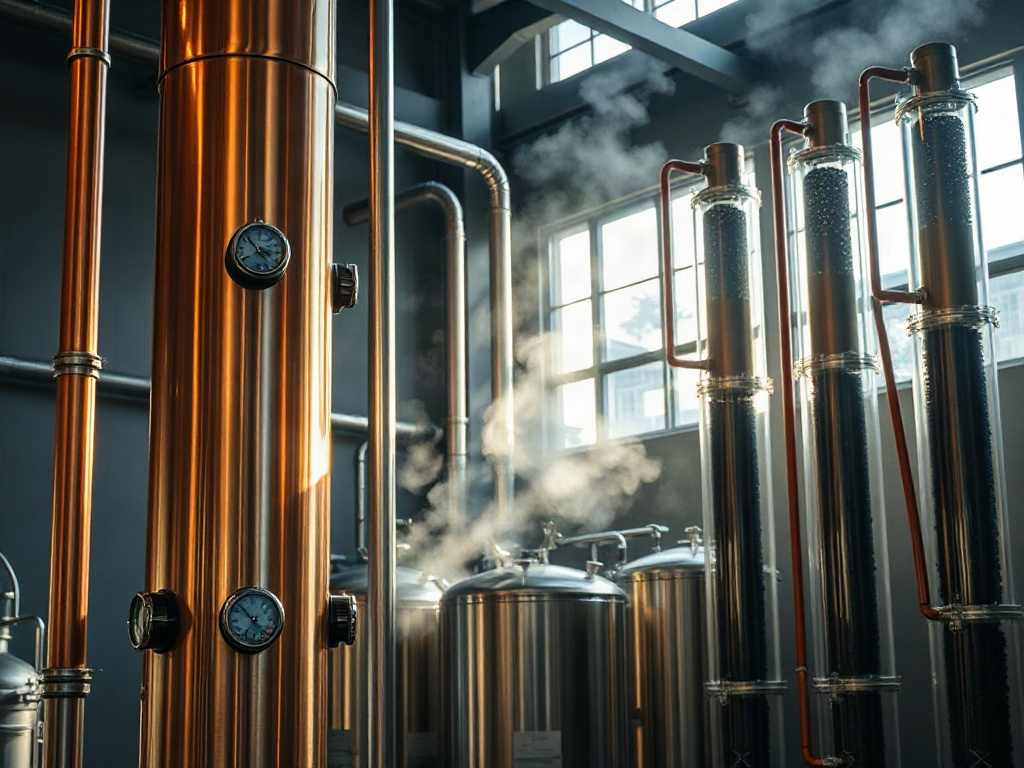
The filtration process works as follows:
- High-proof distillate (95-96% ABV) passes through columns packed with activated charcoal granules or pellets
- Charcoal adsorbs congeners, fusel oils, residual methanol traces, and other flavor compounds
- Multiple passes through fresh charcoal progressively remove more impurities
- Some distilleries use pressure filtration to force spirit through dense charcoal beds more efficiently
Charcoal quality and origin matter significantly. Coconut shell charcoal, birch charcoal, and hardwood charcoal each have different pore structures that preferentially remove different compound classes. Premium vodka producers often specify their charcoal source as a quality indicator.
What Other Filtration Methods Do Distillers Use?
Beyond activated charcoal, modern vodka production employs several additional filtration techniques:
Diamond filtration: Some ultra-premium brands filter through crushed diamonds or diamond-dust-coated filters, primarily as a marketing distinction rather than a functional improvement over charcoal.
Silver filtration: Silver has natural antimicrobial properties and may remove certain sulfur compounds, though its effectiveness remains debated among distilling experts at industry conferences.
Quartz and mineral filtration: Passing vodka through quartz sand or other minerals can provide mild polishing effects and is often combined with charcoal filtration.
Cold filtration: Chilling vodka to sub-zero temperatures before filtration causes certain compounds to precipitate or become more easily adsorbed, enhancing smoothness. This technique is common in Scandinavian production.
Related: How Gin Is Made and What Gives It Flavor | WhichBrewForYou
How Is Vodka Diluted and Bottled?
After filtration, vodka typically exists at 95-96% ABV—far too strong for consumption. Distillers dilute the spirit to bottling strength, most commonly 40% ABV (80 proof) in most markets, though some premium expressions reach 50% ABV or higher.
Why Is Water Quality Critical in Vodka Production?
Water comprises approximately 60% of bottled vodka by volume, making it a major component affecting final taste and mouthfeel. According to research from Harvard's Nutrition Source, mineral content, pH, and purity all influence spirit character.
Many distilleries build their reputation on water sources: glacial meltwater from Iceland, limestone-filtered aquifer water from Kentucky, or reverse-osmosis purified water achieving near-absolute purity. Hard water with high mineral content can create harsh, metallic notes, while ultra-soft water produces smoother vodka.
The dilution process must occur gradually with thorough mixing to prevent "shocking" the spirit, which can cause cloudiness or precipitation. Professional distillers add water in stages, allowing the mixture to rest between additions, and typically chill the vodka to near-freezing temperatures before final bottling to minimize any remaining volatile compounds.
What Are Bottling Standards and Regulations?
Vodka regulations vary by country, but most major markets enforce similar standards. In the United States, the Alcohol and Tobacco Tax and Trade Bureau defines vodka as "neutral spirits so distilled, or so treated after distillation with charcoal or other materials, as to be without distinctive character, aroma, taste, or color."
European Union regulations specify vodka must be produced from agricultural ethanol and distilled to at least 96% ABV before reduction. If produced from non-traditional materials (anything other than grains or potatoes), labels must state the base ingredient.
| Regulation | United States | European Union | Russia |
|---|---|---|---|
| Minimum bottling proof | 40% ABV (80 proof) | 37.5% ABV | 40% ABV |
| Required distillation purity | 95% ABV or higher | 96% ABV or higher | 96% ABV or higher |
| Flavor additives allowed | Only for flavored vodka | Maximum 1% sugar for standard vodka | Not specified |
| Base material disclosure | Optional | Required if non-traditional | Required |
What Makes Premium Vodka Different From Standard Vodka?
The premium vodka market has exploded over the past two decades, with brands differentiating themselves through base materials, water sources, distillation techniques, and filtration methods. But according to Master of Malt blind tasting panels, perceived quality differences often reflect branding and price positioning as much as production methods.
What Actually Influences Vodka Quality?
Base material purity: Higher-quality grains, organic ingredients, or carefully selected potatoes produce cleaner-fermented wash with fewer off-flavors requiring removal.
Distillation precision: Careful cuts between heads, hearts, and tails eliminate harsh compounds. Sloppy cuts include undesirable fractions that filtration cannot fully remedy.
Filtration thoroughness: Multiple filtration passes through fresh charcoal progressively improve smoothness, though diminishing returns set in after 3-4 passes.
Water quality: Premium water sources with optimal mineral content create noticeably smoother vodka than tap water or poorly treated water.
Proof point: Higher-proof vodkas (45-50% ABV) often taste fuller and smoother than 40% ABV expressions because the additional alcohol provides more "body" and mouthfeel.
However, studies published in the Journal of Sensory Studies demonstrate that even experienced tasters struggle to consistently rank vodkas by price in blind tastings, suggesting that beyond a baseline quality threshold, differences become highly subjective.
People Also Ask About Vodka Production
Can you make vodka at home legally?
In the United States, federal law prohibits distilling spirits at home without a permit, regardless of quantity. However, fermentation for beer and wine is legal. Other countries have varying regulations—some European nations allow small-scale home distillation for personal use.
Does vodka distillation remove all methanol?
Proper distillation removes nearly all methanol by discarding heads (first distillate fractions). Commercial vodka contains negligible methanol—typically under 10 ppm—far below harmful levels. Home distillers must carefully make cuts to eliminate heads containing methanol and other toxins.
Why is vodka filtered through charcoal instead of other materials?
Activated charcoal's enormous surface area and porous structure efficiently adsorb organic impurities, oils, and congeners without removing ethanol or water. Its effectiveness, low cost, and food-safety profile make it ideal for large-scale spirit purification compared to alternatives.
Expert Verdict on Vodka Production
The best vodka results from meticulous attention at every production stage rather than any single factor. While marketing emphasizes distillation count and exotic filtration media, the reality is that proper fermentation, precise distillation cuts, thorough charcoal filtration, and high-quality dilution water collectively create superior vodka. Multiple distillations matter only if initial distillation is inadequate—a single well-executed column distillation produces vodka of comparable purity to spirits distilled five times through less efficient equipment. For consumers, understanding production methods reveals that mid-tier vodkas from reputable distilleries often match ultra-premium brands in blind tastings, making informed choices more valuable than price-driven assumptions.
Summary
- Vodka production requires three essential stages: fermentation of starchy or sugary base materials, multiple distillations to achieve 95-96% ABV, and filtration through activated charcoal to remove impurities and create neutral character.
- Base materials include grains (wheat, rye, corn), potatoes, grapes, sugar beets, and alternative ingredients, each contributing subtle characteristics despite vodka's neutral goal.
- Column stills enable continuous distillation with 40-70 theoretical plates per pass, making single-pass column distillation equivalent to dozens of pot still distillations.
- Distillers separate heads (toxic volatile compounds), hearts (clean ethanol), and tails (heavy oils) during distillation, keeping only the heart fraction for vodka production.
- Activated charcoal filtration removes residual congeners, fusel oils, and flavor compounds through adsorption, with water quality during dilution significantly affecting final taste and smoothness.
Frequently Asked Questions
What is the minimum alcohol content for vodka?
In most countries including the United States, vodka must be bottled at minimum 40% ABV (80 proof). The European Union allows 37.5% ABV minimum. During distillation, vodka must reach at least 95-96% ABV before dilution to meet neutral spirit standards.
Can vodka be made from anything?
Yes, vodka can be made from any fermentable ingredient containing starch or sugar, including grains, potatoes, grapes, sugar beets, molasses, corn, quinoa, and even milk whey. The base material must be fermented into alcohol, then distilled to high purity to create vodka's neutral character.
How long does it take to make vodka from start to finish?
Complete vodka production takes 7-14 days from raw ingredients to bottled product. Fermentation requires 2-5 days, distillation occurs in hours to 1-2 days depending on method, and filtration plus dilution takes 1-3 days. Large commercial operations run continuously with overlapping batches.
Why doesn't vodka have flavor like whiskey?
Vodka is distilled to 95-96% ABV and heavily filtered to remove congeners—the flavor compounds that give whiskey, rum, and brandy their character. Whiskey is distilled to only 60-80% ABV and aged in barrels, intentionally preserving and adding flavors. Vodka's goal is maximum neutrality.
Is expensive vodka really better than cheap vodka?
Beyond a baseline quality threshold, differences between mid-tier and premium vodkas are often subtle. Blind tasting studies show experienced judges struggle to consistently rank vodkas by price. Premium brands may use better base materials and more thorough filtration, but well-made mid-tier vodkas can match expensive competitors in quality.
What is the difference between grain vodka and potato vodka?
Grain vodkas (wheat, rye, corn) typically taste slightly sweeter and lighter with creamy texture. Potato vodkas have earthier, heavier character with fuller mouthfeel due to different fermentation chemistry. Both are distilled to high purity, so differences are subtle—most consumers cannot identify base material blind.
More Spirits Articles
This article was produced by an automated research tool. Content is for informational purposes only and should not replace professional advice. Nothing here is medical advice, and it is not a substitute for it. Talk to a doctor about anything affecting your health. Product and resource links throughout this article are included for informational value based on relevance and quality. WhichBrewForYou has no affiliate relationship with any linked third-party site and receives no commission from any recommended products or brands. BellofattoBrews (coffee and tea) and Golden Hive Mead (mead kits and resources) are personal recommendations from this publication's founder and have no affiliation with WhichBrewForYou.