Key Takeaways
- French Press takes 4 minutes total brew time with minimal technique required, while Pour Over needs 3-5 minutes of active pouring attention
- French Press retains coffee oils and fine particles for fuller body, Pour Over filters them out for cleaner taste
- Pour Over requires precise pouring technique and consistent water flow, French Press only needs timing
- French Press produces higher cafestol levels (a diterpene compound), Pour Over removes them through paper filtration
- Pour Over highlights single-origin nuances and acidity, French Press emphasizes body and richness
- French Press costs $20-40 for quality models, Pour Over systems run $25-60 with ongoing filter costs
How Does French Press Coffee Brewing Work?
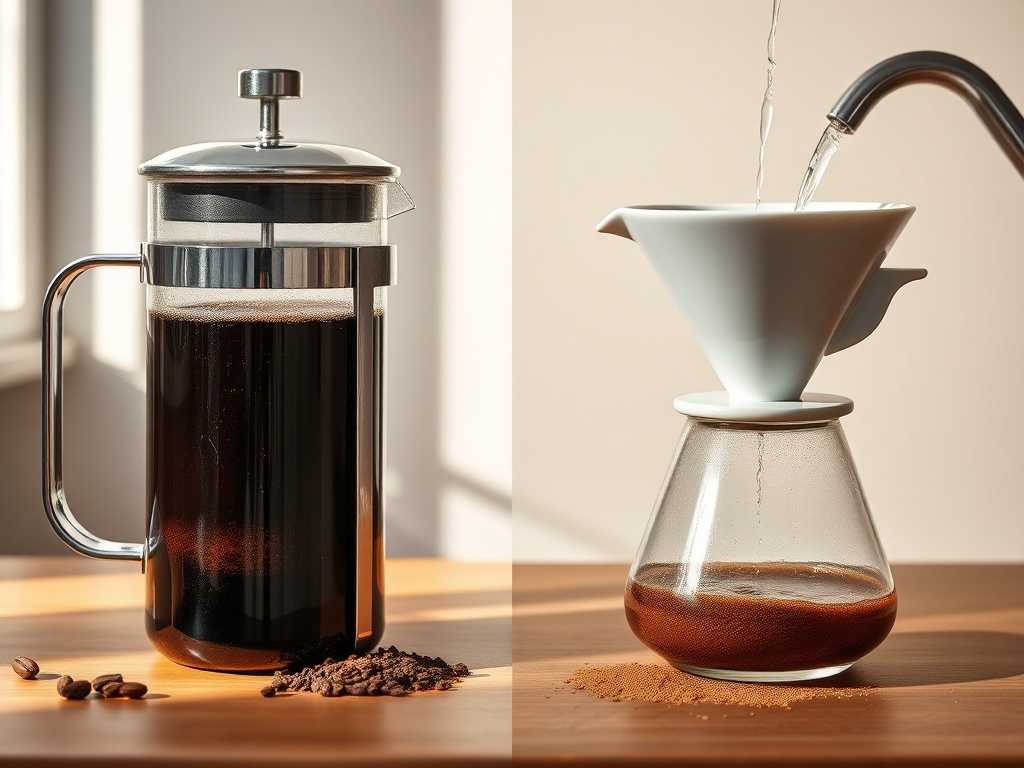
French Press, also called a press pot or cafetière, operates on immersion brewing principles where coffee grounds steep fully submerged in water for a controlled time period. The cylindrical glass or stainless steel carafe contains a metal mesh plunger that separates grounds from liquid after extraction completes.
The brewing process begins by adding coarse coffee grounds to the empty carafe, typically at a ratio of 1:15 coffee to water by weight. Water heated to 195-205°F gets poured over the grounds to saturate them completely. According to the Specialty Coffee Association, optimal extraction occurs between 200-204°F for most brewing methods. After 4 minutes of steeping, you press the metal plunger down slowly, trapping grounds at the bottom while allowing brewed coffee to pour from the spout.
The metal mesh filter contains holes roughly 100-150 microns in diameter. This size allows coffee oils, fine particles, and dissolved solids to pass through into your cup. These compounds, particularly diterpenes like cafestol and kahweol, contribute to French Press coffee's characteristic heavy body and oily surface sheen. Research published in the American Journal of Clinical Nutrition found that unfiltered coffee contains 6-12 mg of cafestol per cup compared to virtually zero in paper-filtered coffee.
Related: Whole Bean vs Ground Coffee: Worth the Extra Effort? | WhichBrewForYou
How Does Pour Over Coffee Brewing Work?
Pour Over brewing uses a conical dripper holding a paper or metal filter positioned over a carafe or mug. Water flows through a bed of coffee grounds under gravity, extracting solubles as it percolates downward in a continuous flow rather than steeping. This percolation method gives the brewer precise control over extraction variables.
The process starts by placing a paper filter in the dripper and rinsing it with hot water to remove paper taste and preheat the equipment. Medium-fine coffee grounds go into the filter, forming a level bed. The brewing sequence follows a specific pouring pattern recommended by the BellofattoBrews brewing guide: a 30-second bloom phase using twice the coffee weight in water, followed by slow, circular pours maintaining a consistent water level.
Popular Pour Over devices include the Hario V60, Chemex, Kalita Wave, and Bee House dripper. Each design affects flow rate and extraction through different hole configurations, filter shapes, and material choices. The V60's single large hole and spiral ribs allow faster flow, while the Kalita Wave's flat bottom and three small holes create more even extraction with less technique dependence.
Paper filters trap coffee oils and particles larger than 20 microns, producing a cleaner cup than French Press. This filtration removes cafestol while preserving flavor compounds, resulting in what many describe as a tea-like clarity where individual flavor notes shine distinctly. According to Coffee Research Institute data, paper filtration removes 95-98% of diterpenes while retaining aromatic compounds and caffeine.
What Are the Key Flavor Differences?
The fundamental flavor difference between French Press and Pour Over stems from oil retention versus oil removal. French Press delivers fuller body, heavier mouthfeel, and rounded flavor profiles where individual notes blend together harmoniously. The suspended oils and fine particles coat your palate, creating a tactile sensation similar to whole milk compared to skim milk.
French Press emphasizes chocolate notes, caramel sweetness, and nutty undertones while softening bright acidity. This makes it excellent for medium and dark roasts where you want richness and depth. Brazilian, Sumatran, and Colombian coffees particularly shine in a French Press, where their naturally lower acidity and full body characteristics get amplified.
Pour Over produces what coffee professionals describe as "clarity" or "transparency." Without oils to muffle flavors, you taste distinct notes sequentially rather than as a blended whole. Fruity, floral, and citrus notes become pronounced. High-grown African coffees like Ethiopian Yirgacheffe or Kenyan AA reveal their complex acidity and berry notes dramatically in Pour Over preparation.
A sensory study by Food Research International found that trained tasters consistently rated paper-filtered coffee higher in "brightness" and "floral notes" while rating immersion-brewed coffee higher in "body" and "bitterness." The same beans produced measurably different flavor profiles based solely on brewing method.
Which Method Offers Better Control?
Pour Over provides significantly more control over extraction variables, while French Press offers simplicity at the expense of precision. This control difference matters most to coffee enthusiasts who want to optimize brewing for specific beans.
With Pour Over, you control six major variables: grind size, water temperature, pour rate, pour pattern, total brew time, and agitation level. Adjusting pour rate alone lets you manipulate extraction percentage by 2-3%, which dramatically affects the balance between acidity, sweetness, and bitterness. Expert brewing guides from BellofattoBrews detail how small technique changes produce measurably different results.
| Variable | French Press Control Level | Pour Over Control Level |
|---|---|---|
| Grind Size | Fixed (coarse) | Adjustable (medium to fine) |
| Water Temperature | Set once at start | Maintained throughout brew |
| Brew Time | Fixed (typically 4 minutes) | Dynamic (2:30 to 4:30 range) |
| Agitation | Initial stir only | Continuous via pouring |
| Water Flow | Not applicable | Fully controlled by technique |
French Press limits you to two real variables: steep time and grind size. Once you pour the water, extraction proceeds automatically without intervention. This predictability makes it nearly impossible to ruin a French Press brew if you follow basic timing.
The technique barrier for Pour Over creates a learning curve. Beginners often pour too fast, causing channeling where water finds easy paths through the coffee bed rather than extracting evenly. According to National Coffee Association guidelines, mastering consistent Pour Over technique takes 10-15 practice brews, while French Press success happens on the first attempt.
What About Convenience and Time Requirements?
French Press wins decisively on convenience, requiring minimal active time and no special technique. Total time from start to cup is approximately 5 minutes: 30 seconds to boil water, 30 seconds to add grounds and water, 4 minutes of hands-off steeping, and immediate pressing. You can walk away during the steep time to prepare breakfast or check emails.
Pour Over demands your continuous attention during the entire brew process. You must execute the bloom phase, then maintain consistent circular pouring for 2-4 minutes without pause. This active involvement means you cannot multitask during brewing. For a single cup, total time runs 3:30 to 4:30 minutes, all requiring focus and technique.
Cleanup time favors Pour Over significantly. A paper filter lifts out with spent grounds in seconds, and the dripper rinses clean under running water in under 30 seconds. French Press cleanup involves dumping grounds (which often require a spoon to remove completely), unscrewing the plunger assembly, and cleaning the mesh screen where fine grounds become trapped. This process takes 2-3 minutes and gets messy if grounds go down the drain.
Batch brewing capacity differs dramatically. French Press easily brews 3-8 cups simultaneously with identical effort to brewing one cup. Pour Over scales poorly—brewing multiple cups requires either multiple drippers or sequential brews, multiplying your time investment. A Chemex handles up to 10 cups but takes 5-6 minutes of active pouring.
Related: Yerba Mate vs Coffee Caffeine — Which Wins? | WhichBrewForYou
How Do Health Considerations Compare?
The presence or absence of cafestol creates the primary health distinction between these methods. French Press coffee contains 6-12 mg of cafestol per 150ml cup, while paper-filtered Pour Over contains less than 0.5 mg. This matters because cafestol is the most potent dietary cholesterol-raising compound known.
A meta-analysis published in the American Journal of Epidemiology found that consuming five cups of unfiltered coffee daily raised LDL cholesterol by approximately 17-21 mg/dL in most adults. The study authors noted that switching to paper-filtered coffee eliminated this effect entirely. People monitoring cholesterol levels should favor Pour Over or limit French Press consumption to occasional use.
Both methods produce equivalent caffeine levels when using identical coffee-to-water ratios and extraction times. The myth that French Press contains more caffeine stems from its typically stronger brewing ratio (1:15 vs 1:17 for Pour Over), not from the method itself. According to USDA FoodData Central, a standard 8oz cup contains 95-165mg of caffeine regardless of brewing method when normalized for coffee quantity.
Antioxidant content remains comparable between methods. Both preserve chlorogenic acids and polyphenols during brewing. The coffee oils in French Press may provide minor additional antioxidants, but the difference is nutritionally insignificant compared to the total antioxidant load from the coffee itself.
Which Brewing Method Works Best for Different Coffee Types?
Coffee origin, roast level, and processing method determine which brewing approach showcases the beans optimally. Light roasts from East Africa excel in Pour Over, while medium to dark roasts from Central and South America shine in French Press.
Pour Over suits light roasts because paper filtration removes oils that might overwhelm delicate flavors while the precise extraction highlights floral and fruity notes. Ethiopian naturals, Kenyan washed coffees, and Rwandan beans with berry and citrus characteristics need clarity to express their complexity. Quality beans from BellofattoBrews' single-origin collection demonstrate how brewing method dramatically affects flavor perception.
French Press complements medium and dark roasts where you want body and sweetness rather than acidity. Brazilian Santos, Colombian Supremo, and Sumatran Mandheling possess inherent chocolate, caramel, and earthy notes that immersion brewing amplifies. The full body extraction balances any bitterness from darker roasting while emphasizing roasted sugar notes.
Blend vs single-origin preferences also matter. Blends designed for espresso or cold brew often include multiple origins balanced for complexity and body—characteristics French Press enhances. Single-origin coffees purchased to taste terroir and processing effects deserve Pour Over's transparency.
Natural process coffees (dried with fruit intact) carry fruity notes and heavier body that Pour Over can either highlight or tame depending on technique. Washed process coffees with clean, bright acidity shine unambiguously in Pour Over. Honey process coffees work excellently in either method depending on whether you want to emphasize their body (French Press) or sweetness (Pour Over).
What Equipment Costs Should You Expect?
French Press systems start at $20 for basic glass models and reach $80 for double-walled stainless steel versions. The Bodum Chambord ($40) and Espro P7 ($100) represent quality options at different price points. Beyond the initial purchase, you need only ground coffee and hot water—no recurring expenses exist.
Pour Over systems range from $25-60 for quality drippers: Hario V60 ($25-30), Kalita Wave ($35-40), Chemex ($45-60), or Bee House ($25). However, paper filters add recurring costs of $8-12 per 100 filters. Heavy users brewing daily spend $30-50 annually on filters alone. Reusable metal filters ($15-25) eliminate this cost but reduce clarity, moving flavor closer to French Press territory.
| Equipment | French Press Cost | Pour Over Cost |
|---|---|---|
| Basic Starter | $20-30 | $25-35 + filters |
| Quality Mid-Range | $40-60 | $35-50 + filters |
| Premium Option | $80-120 | $50-70 + filters |
| Annual Filter Cost | $0 | $30-50 |
Both methods benefit from a gooseneck kettle for controlled pouring ($35-80), though French Press doesn't strictly require one. A quality burr grinder ($40-200) matters equally for both methods since grind consistency affects extraction regardless of brewing approach.
Total three-year ownership costs run approximately $60-130 for French Press versus $120-230 for Pour Over when including filters. This cost difference narrows if you choose reusable Pour Over filters, but then you sacrifice the clarity advantage that defines the method.
When Should You Choose French Press?
Choose French Press when you prioritize convenience, batch brewing capability, and full-bodied flavor over clarity and precision control. This method suits specific situations and preferences exceptionally well.
Morning rush scenarios favor French Press decisively. Set it brewing while you shower, then press and pour without technique requirements. The hands-off steep time accommodates multitasking that Pour Over's active attention prevents.
Group brewing makes French Press the clear choice. Brewing coffee for 3-6 people simultaneously takes identical effort to making a single cup. A large Pour Over like Chemex technically handles multiple cups but requires 5-6 minutes of focused pouring—exhausting for daily use.
Camping and travel suit French Press perfectly. No filters to pack or lose, minimal parts, no special technique required, and stainless steel models survive drops and rough handling. Simply heat water over a camp stove and brew like home.
Budget-conscious drinkers avoid ongoing filter expenses with French Press. After the initial $30-40 investment, you need only coffee beans indefinitely. Over five years, this saves $150-250 compared to buying paper filters.
Coffee drinkers who prefer body and richness over brightness should default to French Press. If you add cream or milk, French Press's oils and body stand up to dilution better than Pour Over's lighter body. Cold brew concentrate and French Press share similar full-bodied characteristics that appeal to the same palate preferences.
When Should You Choose Pour Over?
Choose Pour Over when you want flavor clarity, enjoy the brewing ritual, drink single cups, or want to explore light roast complexity. This method rewards those who view brewing as a mindful practice rather than merely a means to caffeine.
Single-cup brewing fits Pour Over perfectly. Making exactly 12-16oz takes 3-4 minutes with minimal waste. French Press excels at batch brewing but becomes inefficient for single servings since smaller presses (3-cup size) don't extract as evenly as larger models.
Coffee exploration and tasting favor Pour Over's transparency. When trying new origins or roasts, especially light roasts, you want to taste what makes them distinctive. Pour Over delivers this clarity unambiguously, letting you discern Ethiopian berries from Costa Rican stone fruit.
Ritual-oriented coffee drinkers who enjoy the meditative process of brewing find Pour Over satisfying. The required focus, hand movements, and gradual arc from beans to cup creates a morning ceremony that many find therapeutic. Harvard research on mindfulness suggests that ritualistic activities providing focused attention can reduce stress when practiced regularly.
Health-conscious individuals monitoring cholesterol should choose paper-filtered Pour Over. Eliminating cafestol while preserving antioxidants and caffeine makes it the cardiovascular-friendlier choice for daily consumption.
Small kitchen spaces benefit from Pour Over's compact footprint and easy cleanup. A dripper and filters occupy minimal cabinet space and clean in seconds, while French Press requires more storage and dishwasher space for its larger assembly.
People Also Ask
Does French Press coffee have more caffeine than Pour Over?
No, caffeine content is nearly identical when using equal amounts of coffee. The perception stems from French Press's typically stronger brewing ratio and fuller body, which creates a more intense sensory experience.
Can you make Pour Over coffee without a scale?
Yes, though consistency suffers. Use 2 level tablespoons per 6oz of water as an approximation. Visual cues like bloom expansion and draw-down timing help judge extraction without precise measurement.
Why does my French Press coffee taste bitter?
Over-extraction causes bitterness from steeping beyond 4 minutes or using too-fine grounds. Water over 205°F also extracts bitter compounds excessively. Use coarse grounds, time precisely, and pour immediately after pressing.
Expert Verdict: Matching Method to Moment
Neither French Press nor Pour Over is objectively superior—they excel in different contexts. Choose French Press for weekday mornings, group brewing, camping, and medium-to-dark roasts where body matters. Choose Pour Over for weekend ritual brewing, single cups, light roasts, and when you want to taste subtle origin characteristics. Serious coffee enthusiasts should own both, selecting based on the day's beans, time availability, and desired sensory experience. If forced to pick only one, daily convenience drinkers choose French Press, while coffee explorers prioritizing flavor nuance choose Pour Over.
Summary
- French Press produces full-bodied coffee through 4-minute immersion brewing with minimal technique requirements, while Pour Over creates clean, bright cups needing 3-5 minutes of active attention
- French Press retains coffee oils and cafestol (6-12mg per cup), Pour Over filters them out through paper, affecting both flavor and cholesterol impact
- Pour Over offers superior control over extraction variables and highlights light roast complexity, French Press emphasizes convenience and batch brewing capacity
- Total cost over three years runs $60-130 for French Press versus $120-230 for Pour Over including paper filters
- French Press suits morning routines, group brewing, and darker roasts; Pour Over suits ritual brewing, single cups, and origin-driven light roasts
Frequently Asked Questions
What grind size should I use for French Press vs Pour Over?
French Press requires coarse grounds similar to sea salt consistency to prevent over-extraction and reduce sludge. Pour Over uses medium to medium-fine grounds resembling granulated sugar, varying slightly based on dripper type and desired brew time.
Can I use the same coffee beans for both methods?
Yes, but results vary dramatically. Medium roasts work well in both. Light roasts showcase better in Pour Over, while medium-dark to dark roasts express more fully in French Press due to body and oil retention differences.
How do I prevent sludge in French Press coffee?
Use coarser grounds, pour gently when serving, and stop pouring before reaching the bottom of the carafe. Decanting immediately after pressing into a thermal carafe prevents continued extraction and reduces sediment in your cup.
Does Pour Over coffee get cold faster than French Press?
Yes, the thin stream during brewing and smaller brew volume cool faster. Preheating your dripper and vessel with hot water helps. French Press's larger thermal mass and minimal air exposure maintain temperature better, especially in insulated stainless models.
Which method is better for beginners?
French Press offers dramatically easier success for beginners. Consistent results require only timing, while Pour Over demands pouring technique practice. New coffee brewers should start with French Press then explore Pour Over once fundamentals like grind size and coffee-to-water ratios become intuitive.
Can I make cold brew in a French Press?
Yes, French Press works excellently for cold brew. Use a 1:8 coffee-to-water ratio with coarse grounds, steep refrigerated for 16-24 hours, then press and serve. The large capacity and easy filtration make it ideal for cold brew preparation.
More Coffee Articles
This article was produced by an automated research tool. Content is for informational purposes only and should not replace professional advice. Product and resource links throughout this article are included for informational value based on relevance and quality. WhichBrewForYou has no affiliate relationship with any linked third-party site and receives no commission from any recommended products or brands. BellofattoBrews (coffee and tea) and Golden Hive Mead (mead kits and resources) are personal recommendations from this publication's founder and have no affiliation with WhichBrewForYou.